




There will be interpretation in English, French, and Spanish during this event.
Building trust between institutions and communities is a foundational element of effective and sustainable violence prevention. In contexts marked by inequality, weakened social cohesion, histories of abuse, political violence and exclusion, meaningful dialogue between citizens, local authorities, and security actors is often limited or fragmented. Yet evidence from cities around the world shows that creating inclusive spaces for exchange and collaboration can significantly strengthen early warning mechanisms, improve community-police relations, and enable more coordinated and rights‑based responses to violence.
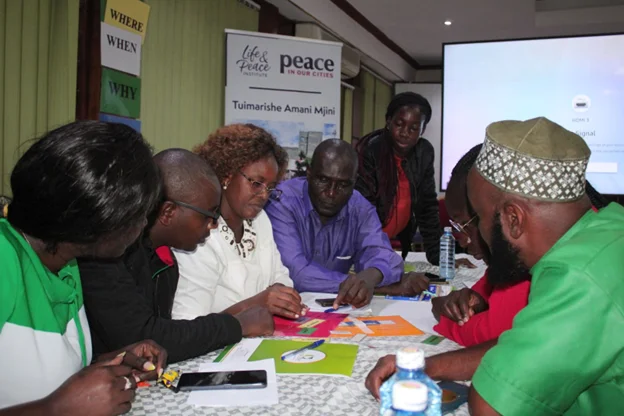
In this webinar, the third of PiOC 2026 series highlighting projects supported by the Peace Incentive Fund (PIF), we will focus on how multistakeholder convenings, such as forums, summits, and dialogue platforms, can serve as practical tools for rebuilding trust and advancing collective violence prevention efforts. These spaces bring together police, local government representatives, civil society organizations, educators, traditional and religious leaders, youth, and the media to discuss safety concerns, unpack violence dynamics, and identify shared solutions. When supported by permanent committees or other types of standing bodies or ongoing coordination mechanisms, these convenings can help sustain momentum beyond individual projects and institutionalize collaboration over time.
Drawing on experiences from PIF projects led by PiOC partners Peace Initiative Network (PIN) in Abeokuta and the Life & Peace Institute (LPI) in Nairobi, the webinar will explore how structured dialogue and inclusive participation can help bridge divides, strengthen accountability, and improve coordination across sectors. Speakers and participants will be able to reflect on and discuss the challenges and opportunities for creating safe and trusted spaces for engagement, how to translate dialogue into action, and how cities can embed multistakeholder collaboration into long‑term violence prevention strategies.
About PiOC’s Peace Incentive Fund
In September 2020, Peace in Our Cities launched the Peace Incentive Fund (PIF), a small grant mechanism focused on bridging knowledge and action by supporting city partners in their efforts to invest in prevention backed by evidence and network research. In 2024, PiOC re-launched the Peace Incentive Fund (“PIF 2.0”) with a new round of financial resources to support efforts in line with PiOC’s 2022 flagship report, Guiding Principles and Inspiring Actions: Operationalizing the Resolution to Reduce Urban Violence.
PiOC selected seven partners for PIF 2.0 with work to be completed during 2025. Projects selected span four broad areas of intervention, with several investments targeting multiple intersecting violence prevention challenges and forms of violence and stretching over four different areas, including: promoting evidence & data-driven prevention; empowering and protecting youth; building trust through multi-stakeholder convening; and developing partnerships & institutional architecture for urban violence prevention. You can read more about all of them in our PIF 2.0 Final Report.