





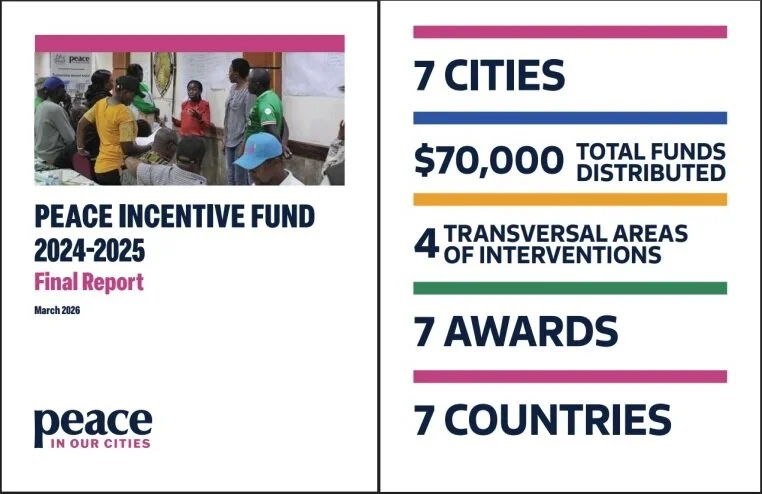
In 2024, PiOC re-launched the Peace Incentive Fund (“PIF 2.0”) with a new round of financial resources to support efforts in line with PiOC’s 2022 flagship report, Guiding Principles and Inspiring Actions: Operationalizing the Resolution to Reduce Urban Violence.
PiOC selected seven partners for PIF 2.0 with work to be completed during 2025. Projects selected span four broad areas of intervention, with several investments targeting multiple intersecting violence prevention challenges and forms of violence and stretching over four different areas, including: promoting evidence & data-driven prevention; empowering and protecting youth; building trust through multi-stakeholder convening; and developing partnerships & institutional architecture for urban violence prevention.
In this webinar, the first of a series PiOC we will be hosting over the next few months to showcase PIF 2.0 interventions, we will be discussing two projects where cities invested in gathering data and evidence to improve the design of local violence prevention policies. With support from PIF, Rosario (Argentina) and Mechelen (Belgium) piloted innovative, data-driven approaches to understand violence, insecurity, and criminal recruitment within their urban contexts. Rosario carried out a citywide victimization and perception survey, revealing trends in crime exposure, underreporting, territorial disparities, and shifting perceptions of insecurity. Mechelen implemented an anonymous youth survey, developed with academic partners, offering the city’s first quantitative insight into youth exposure to criminal recruitment.
This webinar will showcase these two PIF-financed initiatives as practical examples of how cities can generate actionable evidence to inform violence prevention, enhance trust among stakeholders, and design more targeted interventions. Speakers will present key findings and methodologies from their respective surveys, and discuss how survey data is being used to inform policy, resource allocation, and prevention strategies in their respective cities. While operating in very different settings, both projects demonstrate how reliable data can shift policy debates, strengthen institutional coordination, and support prevention strategies grounded in lived experience rather than assumptions.
Speakers
Gonzalo Bonifazi, Director of Violence Prevention, Rosario. Gonzalo Bonifazi holds a degree in Social Work from the National University of Rosario (Argentina) and is the General Coordinator of the Municipal Violence Reduction Program, under the Secretariat of Control and Coexistence of the Municipality of Rosario (since December 2023). The Program integrates the Directorate of Victim Assistance and Empowerment, the Observatory of Coexistence and Citizen Security, and municipal prevention and intervention services focused on highly damaging urban violence. From 2019 to 2023, he served as Director of Victim Support and Empowerment, and from 2011 to 2017, he oversaw the placement of a young adult at the Rosario Adolescent Recovery Institute.
Jonas Van Rossem, Prevention and Safety Project Manager, Mechelen. Jonas Van Rossem (1992) is Project Manager for Prevention and Safety at the City of Mechelen, Belgium. In this role, he coordinates a range of initiatives focused on urban safety and crime prevention, including the development and implementation of an action plan to tackle drug-related crime. He holds master’s degrees in Criminology and in Sexology.